
Schwann Cells (iPSC-derived, Normal)

SKU: 40HU-024

Schwann Cells (iPSC-derived, Normal)

SKU: 40HU-024
Pricing Starting at

Starting at: $1,039.00

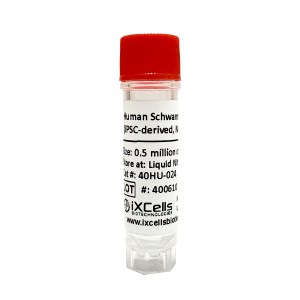
iXCells Human Schwann Cells (40HU-024) are highly pure and can be cultured for up to 21 days without apparent cell death

Available Options

SKUPackage SizePriceQuantityAdd to Cart
40HU-024-0.5MCryopreserved, .5 million cells/vialStarting at: $1,039.00

Associated Products

Description

Product Description

Schwann cells are a type of glial cell found in the peripheral nervous system (PNS). These cells are essential for the myelination of peripheral axons. There are two main types of Schwann cells: myelinating and non-myelinating.

Myelinating Schwann cells wrap around a single axon to form a myelin sheath, while non-myelinating Schwann cells support multiple small-diameter axons without forming myelin. In addition to their insulating role, Schwann cells are active participants in nerve development, maintenance, and repair.

In pathological conditions such as peripheral neuropathies and Charcot-Marie-Tooth disease, Schwann cell dysfunction contributes to disease progression, making them a target of interest for therapeutic intervention. Moreover, their regenerative potential is being explored in biomedical applications, including nerve grafts and tissue engineering.


Product Details

Organism Homo Sapiens, Human
Cell Type Glial Cell
Disease  Healthy
Package Size .5M /vial  
Passage Number P0
Growth Properties Adherent
Shipped Cryopreserved
Storage Liquid Nitrogen
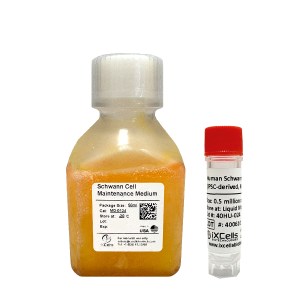
Associated Media  Schwann Cell Maintenance Media (MD-0124)


  1. Fully Differentiated Schwann Cells: Our iPSC-derived Schwann Cells are delivered in an easy-to-use format and are ready for downstream applications only a few days after recovery.
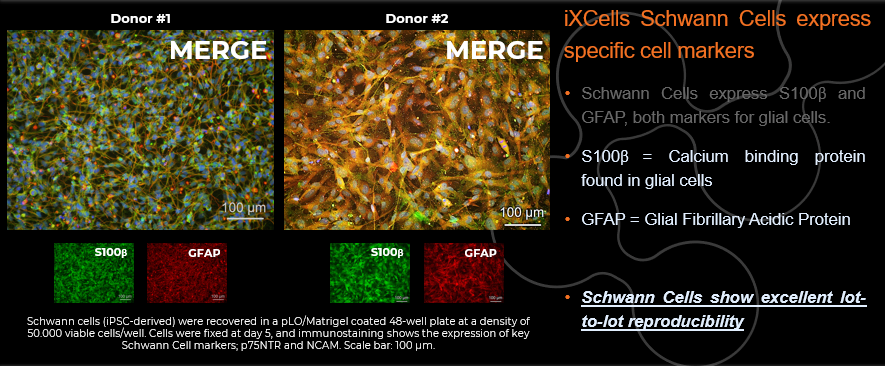
  2. Expression of Relevant Markers: These pure Schwann Cells express key markers including p75NTR, NCAM, S100β and GFAP, confirming their glial identity.
  3. Functionally Validated: Our Schwann Cells can be cultured with Motor or Sensory Neurons to perform myelination assays and improve survival of neurons in culture.
  4. Compatibility with Cell-Based Assays: Our Schwann Cells can used to model different disorders, like Neurofibromatosis. Relevant phenotypes like proliferation or viability after cytotoxic stimuli can be assessed to evaluate drug responses.
  5. Long-Term Culturing Viability: Our Schwann Cells can be mono-cultured for up to 21 days without any apparent loss of cell viability or detachment.

  Datasheet & Culture Protocol

WAIT! ENHANCE YOUR RESEARCH RESULTS.

FREQUENTLY BOUGHT TOGETHER - RECOMMENDED FOR YOU!